

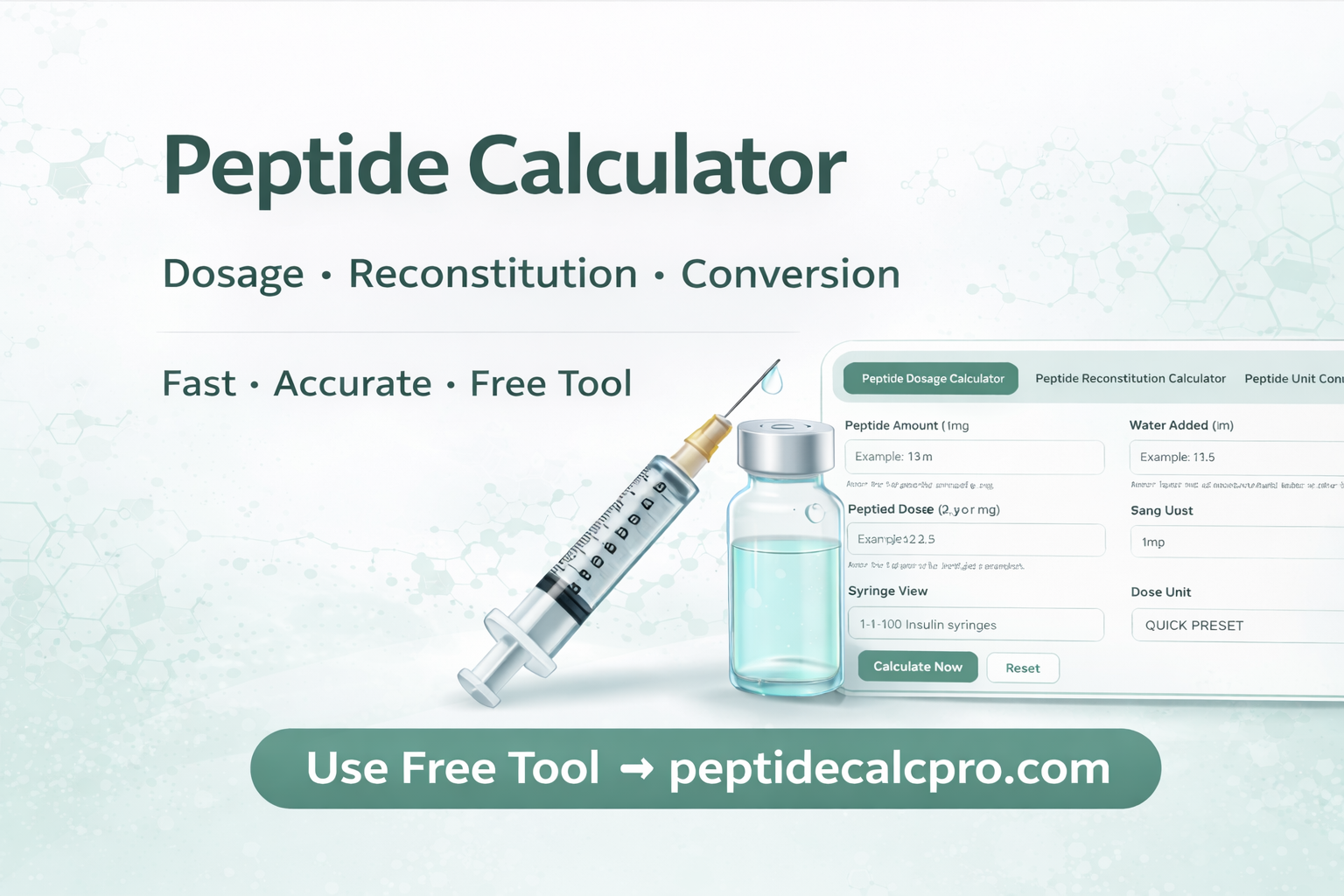
Accurate peptide calculations are essential for achieving consistency during research preparation. Whether you are determining peptide concentration after reconstitution or calculating the correct volume for a desired dosage, precision plays a vital role. A peptide calculator simplifies these mathematical calculations by reducing manual errors and providing quick, reliable results.
Researchers often work with peptides supplied in lyophilized form, requiring reconstitution before use. During this process, several variables—including peptide quantity, reconstitution volume, and target dosage—must be considered. Incorrect calculations can lead to inaccurate concentrations, making reliable calculation tools especially valuable.
For researchers looking to simplify these calculations, OZPEP provides the peptide calculator available at https://ozpep.com/peptide-calculator/, helping users quickly determine concentrations and dosage values while improving calculation accuracy.
What Is a Peptide Calculator?
A peptide calculator is a digital tool designed to calculate peptide concentrations after reconstitution and estimate the volume required to achieve a specific dosage. Instead of manually performing multiple mathematical conversions, researchers simply enter the required values, allowing the calculator to generate accurate results within seconds.
These calculators eliminate much of the guesswork involved in peptide preparation and reduce the possibility of human error. They are particularly useful when working with varying peptide vial sizes and different volumes of bacteriostatic water or other suitable diluents.
By automating complex calculations, researchers can spend more time focusing on their work rather than checking mathematical formulas repeatedly.
Information Required Before Calculating
Before using a peptide calculator, several pieces of information should be available. These values form the basis of every calculation and help ensure accurate results.
Typical information includes:
- Total amount of peptide in the vial.
- Volume used during reconstitution.
- Desired dosage amount.
- Preferred measurement units.
- Target concentration after mixing.
Once these values are entered correctly, the calculator determines the resulting concentration and the amount of solution required for each intended dosage.
Carefully verifying each value before calculating helps improve overall accuracy and minimizes the chance of incorrect preparation.
How Peptide Dosage Calculations Work
Although peptide calculators simplify the process, understanding the basic calculation principles is helpful. After a peptide is reconstituted, the concentration depends on two primary factors: the amount of peptide and the volume of liquid added.
For example, increasing the amount of diluent decreases the concentration, while using less liquid produces a higher concentration. Once the final concentration is known, calculating an individual dosage becomes much easier.
Instead of performing multiple manual conversions, the calculator instantly processes these variables and provides consistent results. This saves time while reducing the likelihood of mathematical mistakes.
Why Accuracy Is So Important
Precision is one of the most important aspects of peptide preparation. Even minor calculation errors can significantly alter the resulting concentration, affecting consistency throughout research procedures.
Using accurate calculations provides several advantages:
- Greater consistency between preparations.
- Reduced risk of calculation errors.
- Faster preparation time.
- Improved confidence in dosage measurements.
- Standardized calculation methods across different peptide quantities.
Reliable calculations also make it easier to reproduce preparation methods when working with multiple peptide batches.
Common Calculation Mistakes to Avoid
Manual calculations can sometimes introduce avoidable errors. Some of the most common mistakes include entering incorrect peptide quantities, selecting the wrong measurement units, or miscalculating dilution volumes.
Other frequent issues include:
- Confusing milligrams with micrograms.
- Recording incorrect reconstitution volumes.
- Misinterpreting concentration values.
- Forgetting to verify decimal placement.
- Using inconsistent measurement units.
A dedicated peptide calculator helps minimize these problems by performing calculations automatically based on the values entered.
Benefits of Using a Digital Peptide Calculator
Digital calculation tools offer numerous advantages over manual methods. They improve efficiency while reducing the complexity associated with peptide concentration calculations.
Some key benefits include:
- Faster calculation speed.
- Improved mathematical accuracy.
- User-friendly input process.
- Consistent concentration calculations.
- Reduced manual workload.
These benefits make digital calculators valuable resources for researchers who frequently perform peptide preparation calculations.
Choosing a Reliable Calculation Tool
Not every calculation tool offers the same level of usability. A reliable peptide calculator should be simple to navigate, support multiple calculation scenarios, and provide clear results that are easy to interpret.
An effective calculator should also minimize unnecessary complexity while allowing users to quickly adjust values whenever preparation requirements change. A well-designed interface improves both efficiency and overall user experience.
Conclusion
A peptide calculator is an essential resource for anyone involved in peptide preparation and concentration calculations. By simplifying dosage calculations, reducing manual errors, and providing consistent results, it supports accurate research preparation while saving valuable time.
Understanding the relationship between peptide quantity, reconstitution volume, and desired dosage allows researchers to make informed decisions throughout the preparation process. When combined with a reliable digital calculator, accurate peptide calculations become faster, easier, and significantly more consistent, supporting better preparation practices and improved workflow efficiency.