

Intravenous therapy used to live almost entirely inside hospitals and infusion suites. Today, a registered nurse can show up at your door with a tackle box of supplies, hang a saline bag from a portable stand, and have you rehydrating on your own couch within minutes. The convenience is obvious, but if you’ve never done it before, the experience can feel a little mysterious. Knowing what actually happens during a first appointment takes most of that uncertainty away.
This guide walks through a typical mobile session from booking to aftercare, with an honest look at what these treatments can and can’t do.
First, what mobile IV therapy actually is
At its core, IV therapy delivers fluids and, in many cases, added vitamins or minerals directly into the bloodstream through a small catheter placed in a vein. Because it bypasses the digestive system, the body absorbs a high percentage of what’s in the bag – which is the main reason people reach for a drip after a stomach bug, a long flight, or a punishing workout.
“Mobile” simply means the clinician travels to you rather than the other way around. The pharmacology is the same one hospitals have relied on for decades to correct dehydration and replenish electrolytes; what changes is the setting and, often, the reason someone seeks it out. That distinction matters, and we’ll come back to it.
The intake comes before the needle
A reputable provider won’t just take your order like a barista. Expect a screening step first, usually a short health questionnaire or a brief consultation by phone or video. You’ll be asked about your medical history, current medications, allergies, pregnancy status, and any kidney or heart conditions – all of which can change whether a particular infusion is appropriate for you.
This is not a formality to rush through. Conditions like heart failure or kidney disease affect how your body handles a sudden volume of fluid, and certain additives interact with prescription drugs. If a service skips this entirely and offers everyone the same “menu” regardless of background, treat that as a red flag rather than a perk. A recent analysis published in JAMA Internal Medicine found that many hydration businesses recommend specific blends without first asking about medical history, which is exactly the gap careful intake is meant to close.
When the clinician arrives
On the day of your appointment, the person at your door should be a licensed professional – typically a registered nurse or, in some models, a paramedic working under physician oversight. Don’t hesitate to ask about credentials; legitimate operators expect the question.
Setup is quick. The clinician will confirm your identity and the plan, check basic vitals such as blood pressure and pulse, and find a comfortable spot for you to sit or recline. They’ll lay out supplies on a clean surface and open everything sterile in front of you. The fluid itself is usually a balanced saline or lactated Ringer’s solution, sometimes with a tailored mix of nutrients depending on what you and the provider discussed.
You don’t need to prepare much beforehand, though arriving well-hydrated and having eaten something light tends to make the whole thing smoother and the vein easier to find.
The infusion itself
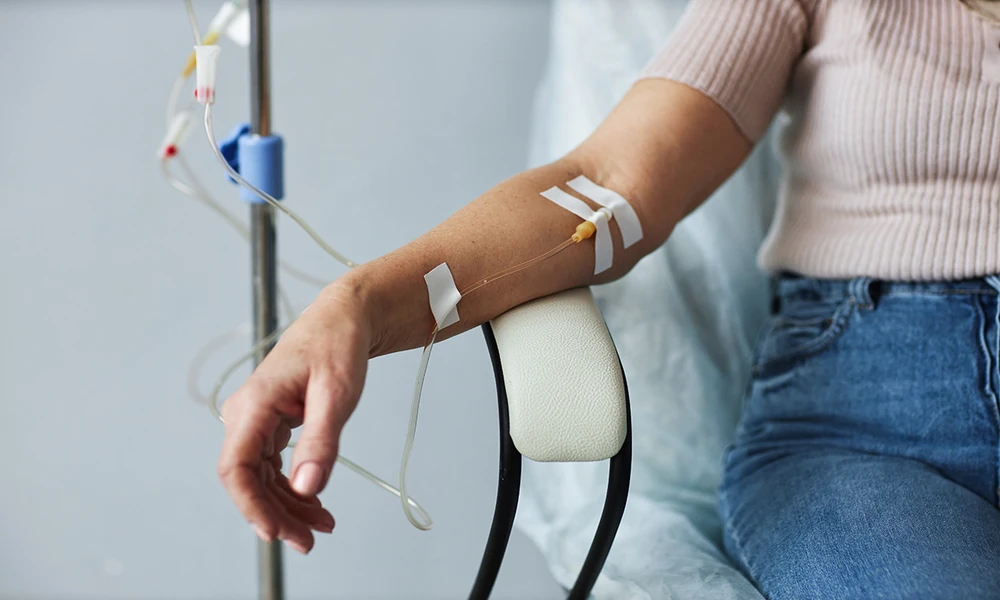
Here’s the part most first-timers worry about. After cleaning the site – usually the inside of the elbow or the back of the hand – the nurse inserts a thin catheter into a vein. There’s a brief pinch as the needle goes in, similar to a standard blood draw, and then the needle is withdrawn, leaving only a soft flexible tube behind. Most people are surprised by how little they feel once the line is in place.
From there, gravity (or a small pump) does the work. A typical bag takes somewhere between 30 and 60 minutes to finish, depending on the volume and your body’s tolerance. You can read, scroll your phone, take a call, or nap. Some people notice a cool sensation traveling up the arm as the fluid enters, or a faint taste – often described as vitamin-like – when certain additives such as B-complex are included. Both are normal and pass quickly.
The nurse stays with you throughout, watching the drip rate and how you’re responding. When the bag empties, they remove the catheter, apply pressure and a small bandage, and you’re done.
How you might feel afterward
Reactions vary. Many people report feeling refreshed or less sluggish, particularly when they were genuinely dehydrated to begin with. Others feel pleasantly unremarkable, which is also a perfectly fine outcome. Mild bruising at the insertion site is common and fades within a few days.
It’s worth setting realistic expectations. The strongest, most predictable benefit of an IV drip is rapid rehydration and electrolyte balance. The broader wellness claims – boosted immunity, detoxification, reversing fatigue in people who aren’t deficient – rest on much thinner evidence. As physicians at the Mayo Clinic have noted, the marketing around vitamin infusions has outpaced the research, and a drip is no substitute for a strong foundation of sleep, nutrition, and movement.
Safety and oversight: the part worth slowing down for
IV therapy is generally low-risk when it’s done well, but “done well” carries real weight. Any time a catheter enters a vein, there’s a small chance of infection, vein irritation, or, rarely, fluid overload – which is precisely why sterile technique and clinical screening exist.
Regulators have flagged the cases where corners get cut. Several professional bodies, including the National Association of Boards of Pharmacy, have echoed an FDA caution about infusions prepared under unsanitary conditions at some hydration businesses. The takeaway isn’t that mobile IV therapy is inherently unsafe – it’s that the safeguards you’d expect in any outpatient medical setting should travel with the clinician to your living room.
Choosing a provider you can trust
A few signs separate a credible service from a novelty:
- Treatments are administered by licensed clinicians, not unsupervised staff.
- There’s a genuine medical screening before anyone books a drip.
- Ingredients, sourcing, and pricing are transparent and explained plainly.
- The provider sets honest expectations instead of promising cures.
Companies built around these principles tend to treat the home visit as a clinical encounter rather than a delivery service. Providers like Heights IV, for instance, structure their visits around a nurse-led assessment, and their in-home IV treatment options are matched to a person’s stated goals rather than offered as one-size-fits-all. That kind of structure is a useful benchmark even if you end up choosing someone else.
The bottom line
Your first mobile IV session is usually calmer and quicker than people expect: a short intake, a quick pinch, a half-hour or so of sitting still, and a tidy bandage on the way out. Treated as a convenient way to rehydrate and recover – and chosen through a provider that screens carefully and staffs professionally – it can be a genuinely pleasant experience.
The smartest move before that first appointment is the simplest one: have a quick conversation with your own doctor, especially if you manage a chronic condition or take regular medications. A drip can be a helpful tool. It works best as one part of looking after yourself, not a shortcut around the rest.
