

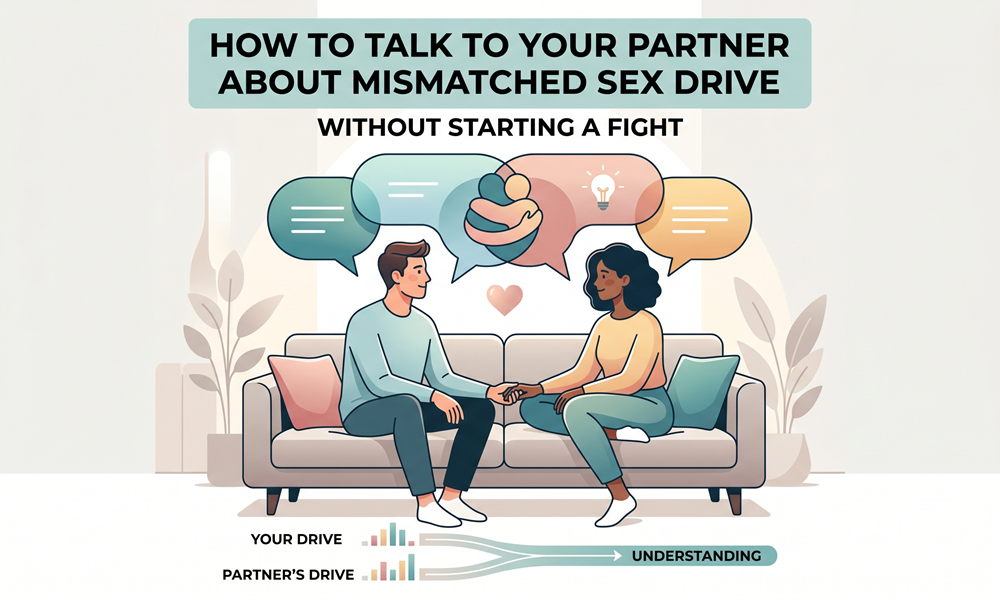
Mismatched sexual desire is one of the most common and least openly discussed challenges in long-term relationships. When one partner consistently wants more sexual intimacy than the other, the dynamic that develops around that gap is often more damaging than the gap itself. The higher-desire partner may feel rejected, unattractive, or chronically frustrated. The lower-desire partner may feel pressured, guilty, or defensive. Both can end up feeling misunderstood and increasingly reluctant to address the subject directly.
The conversation about mismatched desire does not have to produce a fight. With the right timing, framing, and intentions behind it, it can become one of the more connecting conversations a couple has. Here is how to approach it.
Start by Examining Your Own Assumptions
Before you raise the subject with your partner, it is worth spending some time with your own assumptions about what the mismatch means. Many higher-desire partners interpret their partner’s reduced interest as a personal rejection, a sign that attraction has faded, or evidence of a deeper relational problem. Many lower-desire partners interpret their partner’s continued interest as pressure, criticism, or evidence that their needs in other areas of the relationship are not being acknowledged.
Both interpretations may be partially accurate or entirely inaccurate, but approaching the conversation while holding them as given facts makes productive dialogue almost impossible. Entering with genuine curiosity about your partner’s experience, rather than a prepared case for your own position, changes the entire dynamic of the exchange.
Choose the Right Time and Setting
This conversation should never happen in bed, immediately before or after a sexual encounter, or in the middle of a disagreement about something else. It needs its own space, when both of you are reasonably relaxed, not rushed, and not already emotionally activated. A walk, a quiet evening at home without distractions, or even a deliberate sit-down conversation started with an honest opener like ‘There is something I have been wanting to talk about and I want us to be able to really hear each other’ signals that what follows deserves attention. If desire discrepancy has been a recurring source of tension in your relationship, professional sexual wellness counseling can provide a structured and supported environment for this conversation when doing it alone keeps leading to the same impasse.
Use Language That Describes Your Experience, Not Your Partner’s Behaviour
The fastest way to turn a sensitive conversation into an argument is to frame it as a complaint about what the other person is doing or not doing. Statements that begin with ‘you never’ or ‘you always’ or ‘you make me feel’ place the other person on the defensive immediately. Defensiveness closes down honest communication.
Describing your own experience keeps the conversation about you rather than about what your partner is failing to provide. There is a meaningful difference between saying ‘You never initiate any more and I feel like you are not attracted to me’ and ‘I have been feeling a disconnection between us physically and I miss the closeness we used to have.’ The second opens a door. The first puts your partner behind it.
This is not about softening the truth or avoiding difficult subjects. It is about creating the conditions in which your partner can actually hear what you are saying rather than reacting to the way it is being said.
Make Space for Your Partner’s Experience Too
A productive conversation about desire is a two-way exploration, not a presentation of grievances. After you have shared your experience, genuinely invite your partner to share theirs. What does intimacy look and feel like from where they are standing? Are there things in the relationship, or outside it, that are affecting their desire that they have not known how to raise? Are there ways they experience connection and closeness that differ from yours?
Desire discrepancy is rarely a straightforward case of one person being more sexual than the other. It is frequently entangled with stress, emotional connection, physical health, the dynamics of who initiates and how, unresolved relational tension, or differing ideas about what counts as intimacy. Uncovering those layers requires both partners to feel safe enough to be honest.
What to Do If the Conversation Keeps Going in Circles
Some couples find they can have this conversation productively on their own. Others find that the same patterns repeat regardless of how carefully they approach it: the same defensiveness, the same shutdown, the same feeling of talking past each other. If that is your experience, it is not a sign that the relationship is beyond help. It is a sign that the conversation needs a different container.
A therapist who works specifically with desire discrepancy and sexual communication provides both a structured framework for the conversation and a neutral presence that changes the dynamic. It is much harder to escalate into defensiveness when someone is facilitating the exchange, and it is much easier to hear your partner’s experience when you are not simultaneously managing your own emotional reaction to it.
If desire discrepancy has been a persistent source of tension and the conversations you have had so far have not led anywhere, exploring specialised therapy for mismatched sexual desire is a practical next step. The goal is not for one partner to change who they are. It is for both partners to understand what is happening and find a path forward that works for the relationship they actually have.